

My longest passage... yet
Another unintended milestone

Note to Reader: This post might be a bit detailed for the non-sailor, but it contains route information that may challenge your knowledge of geography. I hope you enjoy it!
Once I had decided that Japan was my destination, I had several choices on how to get there from Fiji.
One path would take me north/northwest from Fiji to the Marshall Islands or the Federated States of Micronesia, where I would linger until roughly March for a favorable weather window. These islands are the spawning grounds for typhoons, they have limited resources and boat service facilities, but most of all I dreaded the idea of spending 3-4 months here by myself.
The second option would take me to the Solomon Islands and Papua New Guinea with a similar waiting pattern until March. There is a bit more activity here, although there have also been a few reports of thefts and violence towards boaters. I didn’t feel comfortable with this option either.
The third option was to sail directly from Fiji to Japan. Aside from the length of such a passage (4000 nautical miles), the main drawback to this option was the possibility of late-season typhoons in the North Pacific, as well as unsettled weather farther south. 4000 miles means roughly 30 days on passage, which would also test me mentally.
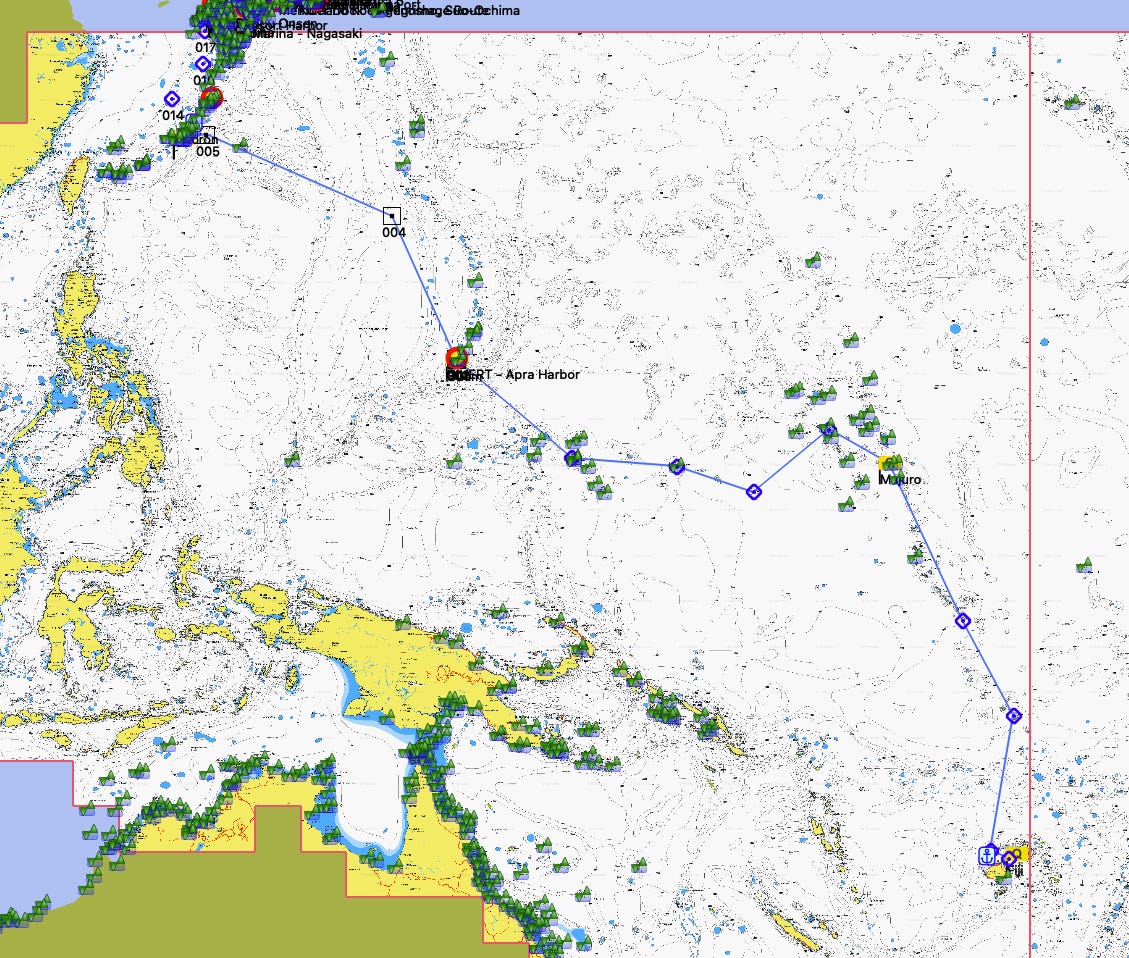
San Francisco was calling me, and Japan was the only one of these three destinations that had marinas where I could safely leave my boat and travel back home. Jamie on SV Totem helped me find a way to get to Japan with the weather conditions we had, and this made my choice clear.
I drafted and filed my Float Plan, which for this trip was 16 pages long. It contained information on how to reach me, what to do when that was not possible, how to track the boat’s position, and how to initiate a search and rescue request in the event of my disappearance. I would be crossing five search and rescue jurisdictions on this journey, so each of their contact phone numbers and email addresses had to be vetted. Having to think like this might sound morbid to some; I find it comforting to have planned for the worst and performed at my best to avoid such outcomes.
I also had to arrange the check-out process from Fiji, and Mr. Lais at Fiji’s Revenue and Customs Service was a flexible and gracious civil servant who understood that the weather forecast was driving the decision on when I could schedule my departure date with him.
Once the weather window was decided, a final provisioning run was required the day before departure (to ensure the freshest food). Fruits, vegetables and meat were purchased, their packaging stripped away, and everything repacked in vacuum containers (to minimize garbage stored aboard on passage).
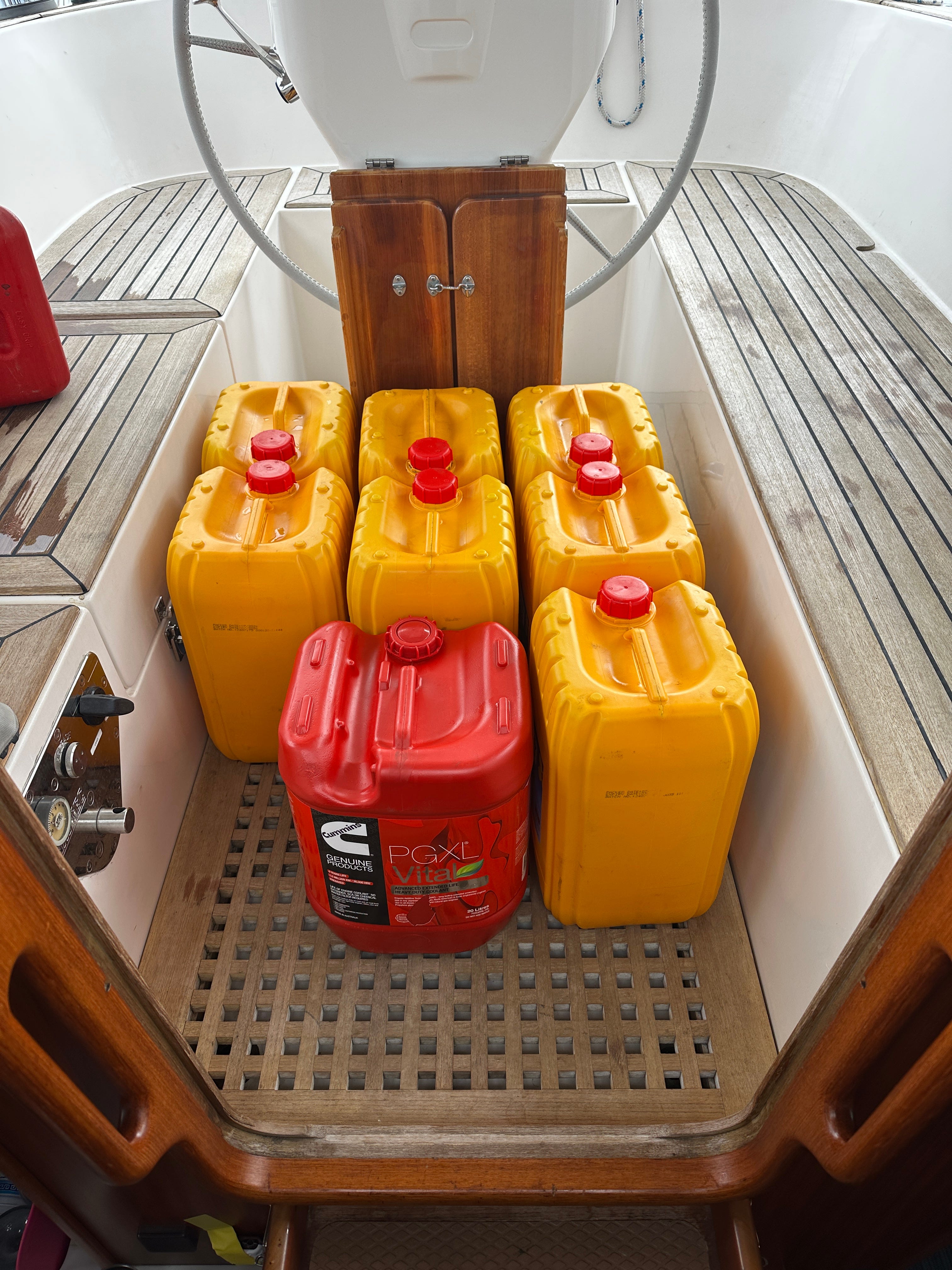
Because of a large area of squall activity and no winds, in what is known as the South Pacific Convergence Zone, I asked my Fijian friend Tasleem to help me procure and fill twelve 20-liter fuel containers which, together with the four external tanks I already had, boosted my motoring range by 40%. This extra fuel capacity would be crucial on the 4000 nautical mile non-stop journey.
Water tanks were topped off, many loads of laundry done, and boat checks completed. There is a nervous energy that develops in me as I get close to the departure date, similar to butterflies a musician experiences before going on stage. That energy keeps me focused on the boat prep tasks, and probably makes me seem more distant from others.
True to Jamie Gifford’s (SV Totem) prediction, there was no wind for 5 days and I motored continuously north towards the equator, dodging squalls and lightning along the way. This was not comfortable sailing as the worry of a lightning strike loomed constantly. But fortunately nothing bad happened and the days ticked on as I carried north and passed the equator for the second time on this Pacific circumnavigation.
I contemplated the option of a stop in Kosrae or Pohnpei in the Federated States of Micronesia to refuel, but after more conversations with Jamie and a review of my fuel supply, I decided to carry on towards Japan. My route took me just west of Pohnpei, passing it in the middle of the night and not seeing anything save for storms everywhere on radar. This was probably the time I felt most anxious; there’s absolutely nothing you can do -other than to pray- when lightning is flashing in the distance.
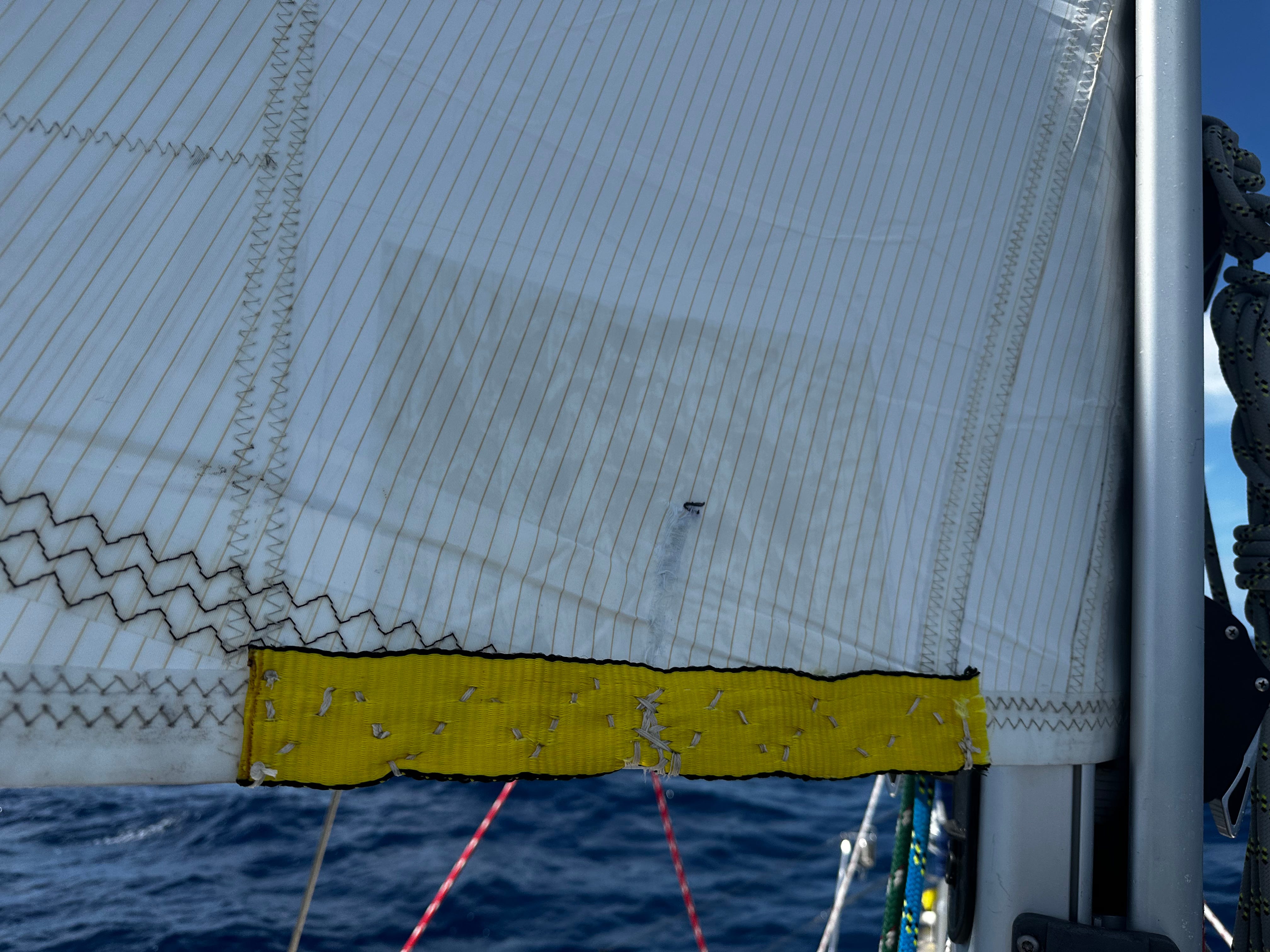
The mainsail tore -again- during this passage, in the same general area as before, and Jamie taught me how to stitch a patch without taking down the sail. That was “interesting” experience trying to balance myself against the mast, and hand stitching the webbing in place. But it worked well enough until I could solve this problem permanently at a sailing loft in Okinawa1.
While I had enough fuel to make it to Japan non-stop if there were no surprises (like a torn mainsail), I wouldn’t have enough if the weather or mechanical problems worked against me. Several calls and emails to the Guam Port Authority followed, and I scheduled a 24 hour stop at Agat Marina and a fuel truck to deliver 500 liters of diesel fuel. I also made a quick visit to the supermarket and was driven by one of the port authority staff to their offices to complete my check-in/check-out paperwork, then back to the boat. They were so very friendly, and I hope to come back to Guam for a proper visit.
The route out of Guam took me north and to the west side of the other Mariana Islands (Saipan, Tinian, etc), and two days later I made a turn to the west and towards Okinawa. Winds were strong on this final stretch, coming directly from Okinawa, and the last two days were brutal, with 3+ meter seas and forward progress at less than 3 kts for each of the next 48 hours.
But arrive at Okinawa I did, on December 29, 2024 at 8:15am. I’ll leave those details for my next post.
The root of the problem with the mainsail is that the fabric is laid out with its main tension-bearing fibers running in a vertical direction. This is normally acceptable across most of the sail area, except on the foot (bottom part) of a furling mainsail, which is subjected to horizontal tension. As the sail is furled into the mast, the area of fabric between those vertical fibers is absorbing tensional loads they were not designed for, and the tears are happening at these spots. Therefore, the fix is to cut out about 30cm / 12 inches of sailclost at the foot, and to sew on new material with the fibers running perpendicular to the original layout. This fix has been completed since my arrival in Okinawa and the mainsail used extensively without further incident.